
Product Classification
Stay informed about the latest industry trends, technological innovations, company milestones, and upcoming events from Magpow.
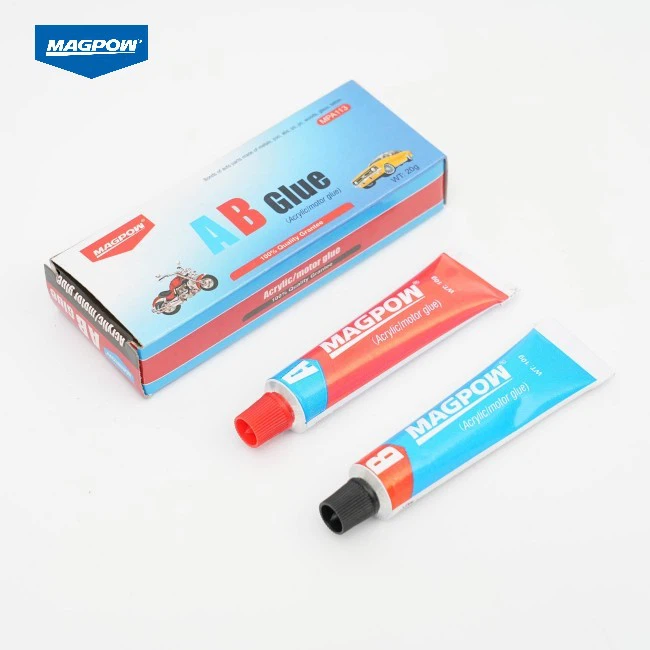
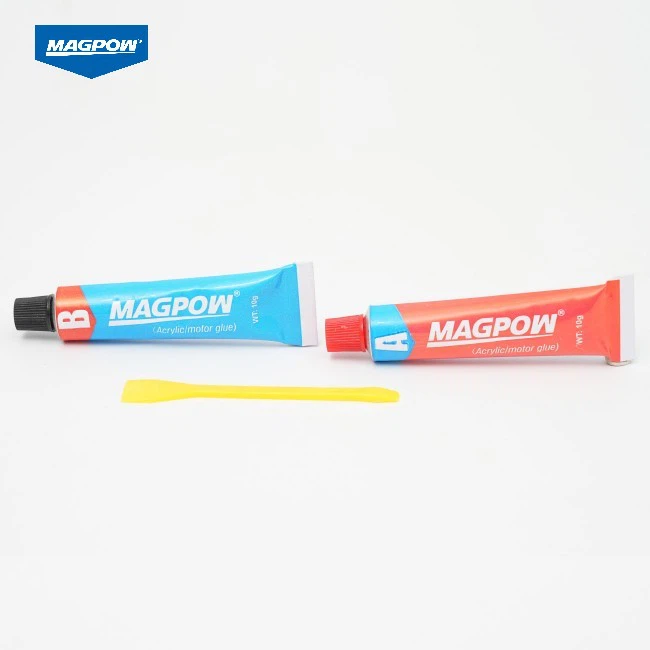
Acrylic Glue For Plastic
Magpow Acrylic Glue For Plastic exhibits excellent resistance to water, oils, acids, and alkalis, and retains its stability in high-temperature conditions.
DESCRIPTION
Feature
- This two-part structural adhesive, based on acrylic technology, delivers high-performance bonding.
- The adhesive's two components (Part A and Part B) are combined in equal proportions to create a resilient and long-lasting bond.
- Its applications extend across industrial, automotive, and domestic settings.
Main Component
A component is the modified Acrylic ester, B component is Modified Curing Agent
Specification
MPA113: 20g/box, 100boxes/ctn
Application
Acrylic Adhesive is engineered for reliable repair and sealing across diverse surfaces such as iron, steel, aluminum, stainless steel, ABS plastics, PVC, polystyrene, glass, concrete, and similar specialized materials.
Perfect for everyday home fixes, as well as for upkeep of cars, motorcycles, and farm machinery, it can be applied to various mechanical parts. This glue also performs well in products like speakers, lifts, door assemblies, electric motors, measuring devices, laundry machines, freezers, and similar appliances.
Moreover, it is well-suited for use in fire protection systems, eco-monitoring instruments, artisanal crafts, textile manufacturing equipment, and machinery used in metal processing and refining industries.
Technical Data
| Name of Product | AB Glue |
|---|---|
| Appearance | Component A is light blue thick liquid Component B is light red thick liquid |
| Applying Temperature(℃) | -30-100 |
| Curing Time (25℃,min) | ≤10 |
| Shear strength (Steel-Steel,Mpa) | ≥10MPa |
Using Method
Step 1: Work Area Preparation
- Work in a well-ventilated area and wear protective gloves.
Step 2: Mixing
- Avoid large-scale mixing at once to prevent rapid exothermic reaction.
Step 3: Storage
- Keep cool under 20℃, keep dry, seal, valid within one year. Avoid direct sunlight.
Step 4: Transportation
- Preserve and transport as non dangerous products. Can be transported.